Monday, September 28, 2009

KOREA Week XXII

Monday, September 28, 2009 at 10:20pm

Temperatures have been increasingly colder here in the South of Korea. It's amazing how similar they actually are to temperatures in the Midwest of America, though the fall temperatures here seem to be a few weeks behind their U.S. counterparts. Recent days have been comfortable in the mid to upper 70's, while nights may drop down to mid to lower 60's or even upper 50's, Fahrenheit, of course. I have also noticed some leaves beginning to fall, though most leaves have yet to turn color and will probably not do so until mid to late October.

Teaching continues to go well, though I miss the record high number of students experienced during the summer vacation months. Mostly, I miss some of the students I taught the past five months, and I wish they would return to school or I could pick and choose my students. One of my favorite classes is Happy Class, a discounted class offered late mornings on Monday/Wednesday for mostly housewives. We always have good discussion and they are a great class, though I sometimes think the students grow tired of the topics I select (usually cooking, cultural differences, my Korean travel plans, etc.) Kelly, Young, Cool, and Christine have each been in the class for several months now and we have an excellent relationship. In fact, sometimes we have lunch together immediately following class, coffee, or I prepare peanut butter and jelly sandwiches for the group. Kelly, Young, and Christine have also been instrumental in helping me adjust to Korean life and find my way around town. For this, I am incredibly grateful.

Another of my other favorite classes is Business English taught every Tuesday/Thursday evening. Good friend and favorite student B.H. has been a prominent fixture in this class from Day 1, and the number of students continues to grow each month. Currently, we are up to a record high 9 students enrolled this month in the class. Possibly some of my best lessons and class discussions have been here. Maybe it's just because I'm a Business major or have a profound interest in the subject, but some of our discussions have included: the competitive advantage of Starbucks in Korea, analysis of Hyundai Kia Automotive Group and their recent success, use of technology and innovation in our daily lives and how to apply this to our professions, economical issues, etc. Actually, if enrollment continues to increase, I hope to convince the school to open a second Business English class offered in the morning.

I have but a few complaints with teaching, and they are all minor. First of all, some Koreans do not stay home when they are sick. Instead, they come to class sneezing and coughing for others to see and be exposed to. It's a bit annoying, especially when many here blame the foreigners for exposure to swine flu. I have made it a practice to keep hand sanitizer in class and make sure to wash thoroughly after touching items in the classroom, after every class, just to be safe.

Another complaint are the few students who attend class once or twice a month, and usually do not have much to contribute when they do attend. It's silly for me to complain about this as it's their money they're wasting, but I truly do care about the students and the quality of the education I offer them. Another complaint along this line is one particular class I am teaching this month where the students do not like to speak or have difficulty becoming active in the class discussion. After four weeks, I am so frustrated with the class, I have told the school I cannot teach them after this month. It's incredibly aggravating, and James, who taught this class last month, had the same frustration with them. I guess I should be fortunate that, after five months, this is the only class I have experienced this difficulty with.

Aside from these minor complaints, and really, they all seem trivial, I can honestly say I love teaching and I'm delighted with my decision to be here. Teaching is something I never thought I would do in my adult life, let alone be any good at, and it's surprising where life can lead you. This experience, I think, so many friends of mine would not only enjoy, but surprisingly, be very good at. One of the best parts about my job, aside from the friendships I have forged with many students, is the laughter we often share together in class. It's these jovial and outgoing individuals who make my teaching experience worthwhile.

I have begun to get this same satisfaction from my experience reading children's books at the library on a weekly basis. Once again, this is something I never thought I would enjoy, let alone be successful with. Each week, there are usually between 20-40 children, perhaps 5-8 years average age, with another 10-20 parents in attendance. I recognize many of the same faces each week, and on most days I am lucky enough to get a big smile or sometimes even a hug from them. Some of the children have also brought me presents. Others remain skeptical around me and prefer their comfort of their parent's arms. Not to sound incredibly lame, but I find this to be a very rewarding experience and it makes me feel good to give something back.

An interesting observation is just how incredibly well young Korean schoolchildren can speak English, and often, with little or no accent at all. Usually, the older students speak with some form of an accent, even a slight English or Australian accent depending upon if they may have studied or lived abroad. The reason for the difference is because the older students did not begin their studies until a later age, perhaps middle school, and this difference is largely noticeable.

English education at a pre-school or kindergarten age remains a controversial subject here in Korea. In fact, this topic has been the source of many discussions in class. It truly is unbelievable the importance and emphasis on English skills in this country, as it seems to be a pre-requisite for college entrance and employment. In other words, one's English ability determines their place in society, and it beckons the question if the Korean language will someday disappear or simply fade away.

The positive side, of course, is the high demand this creates for native English teachers, such as myself. Korean institutions and public schools pay attractive salaries, provide good benefits and usually free housing for foreign teachers. ESL teaching really is a remarkable way to experience life outside North America and learn about a foreign country, it's people, their history and language.

Here's another observation. Students in my Saturday a.m. class and were discussing American holidays and the subject of parades came up. Korea, apparently, rarely has parades, which is disappointing. I was told they used to have a parade every year for Soldiers Day, first week of November, though this practice has ended within the past ten years or so. When asking my students why there no longer is a parade on Soldiers Day, I was told because the tanks destroyed the roads. Apparently, Soldiers Day in Korea used to present to the public a massive march of thousands of soldiers accompanied by a an arsenal, literally, of military equipment, missiles, tanks, etc. Wow!

The approaching weekend, October 1-4 is Korean Thanksgiving, Chuseok, and it's a four day holiday from my school. I have learned Chuseok is, perhaps, one of the most important Korean holidays and, similar to the U.S., is a time for families to gather and celebrate the good things in life. Small gifts are often shared with others, delicious foods are prepared, and many, many people travel, thus making it difficult to go anywhere. Despite the logistical difficulties, I have managed to secure KoRail passage to Pusan, where I will visit with Toledo friends Greg and Brian, and Greg's girlfriend, Suji. Another fun weekend, I am sure, will be had by all.

Best wishes!

Monday, September 21, 2009

KOREA Week XXI

Monday, September 21, 2009 at 3:45pm

Wibro Wireless internet has arrived in my Korean life! It's a USB plug-in antenna which allows me, in theory, to connect to the internet anywhere in the Gyeonggi-do province (metro Seoul area). I signed a twelve month contract with KT Telecom for 22,000 Won per month and no out-of-pocket expense. Not bad, though I had to return to COEX Mall last week for a complete reinstall of the Wibro software on my computer. Hopefully, this proves to be a convenient and trouble-free solution to the internet connectivity issues which have plagued me from day one in Korea.

I recently learned that one of my students in Step 4 class lived in Ann Arbor, MI for three years and studied at Wayne State University in Detroit. Small world; though she didn't seem to know much about Toledo and Northwest Ohio. Nonetheless, it was a nice connection to make and we have since had many interesting discussions about Ann Arbor and her short time spent there.

Last week, I returned to my new favorite restaurant in Sanbon, and location of the nearly disastrous oil fire during my second visit there. Thursday night, I treated two of my favorite Korean friends, B.H. and Gemma, to late night Galbi dinner. It was a great evening shared with two great people, and together the three of us feasted on thinly sliced beef, the many traditional Korean accompaniments, and Ginseng soju from my personal stash that I now keep at the restaurant. That's right, I have my own bottle of Ginseng-soaked soju with my name proudly written on it and kept on hand at the restaurant.

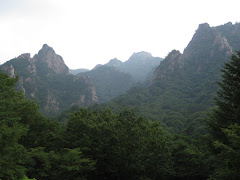
There was no class Friday, so I ventured South to meet Toledo friend Greg and his Korean girlfriend, Suji, in JiriSan National Park. JiriSan National Park is the largest of the Korean National Parks and boasts some of the tallest, steepest terrain in the country. Overall, it was a wonderful weekend, and nice to reconnect with this contingency from Toledo/Pusan.

Because of the late night Thursday, I did not actually leave Sanbon until close to 3pm Friday, which meant taking the 4pm bus from Nambu Bus Terminal In Seoul and 8pm arrival in JinJu. A major mistake on my part, but worth it because Thursday night was a great time. From JinJu, it's another hour long bus ride to Jung San Li, the mountain location of the resort we stayed in. Unfortunately, my late night arrival in a strange country town without street lights led to me getting lost and wandering for over an hour before finally locating the resort around 1030pm.

I am incredibly fortunate every time I travel in Korea, as I always seem to have good luck and encounter some friendly Korean who speaks just enough English to assist me. In this case, I met my new Korean friend on the bus ride to Jung San Li, and after getting lost the first time, he helped guide me to the resort. Additionally, he joined me for late night dinner and shared the cost of the hotel room for the first night so my cost was only 20,000 Won instead of the standard 40,000 Won.

What was most disappointing about my weekend travel was immediately following the hour long bus ride to Jung San Li, when the nasty bus driver insisted I pay him a second fare. This was despite the fact I provided my original ticket to a different attendant upon entering the bus, who eagerly accepted my ticket, helped me handle my luggage, and showed me to my seat. The driver's attitude really rubbed me the wrong way, but as my new Korean friend pointed out using subtle English vocabulary, "it's okay. Pay the man the money and let's go." Even though it was only 6,000 Won, I still felt cheated and it did not sit well with me.

Greg and Suji arrived early Saturday morning, 10am, from Pusan, and we enjoyed a quick breakfast before departing for our day hike to the mountain. Originally, we were told 7-8 hours to the summit and back (11 km.), though less than one hour into the hike, we quickly realized this was near impossible due to the steep, rocky terrain that was the trail. Instead, we hiked two hours to Beopgye Temple, enjoyed a free lunch sponsored by the temple staff, and lingered here for almost two hours before returning down the mountain. It was the correct decision, because there is no way we could have reached the summit and made it safely down the mountain prior to darkness setting in. The terrain was too steep and too challenging to negotiate in dim light or the dark. As it was, the hike to/from the temple was 7 kilometers and was challenging. Besides, it gives us an excuse to return for a 2-3 day overnight hike and camp on the mountain; something we are currently planning for.

So, we returned to our resort motel at around 6pm Saturday where we each showered, relaxed, and prepared a phenomenal four course meal complete with pork tenderloin, beef tenderloin, sauteed vegetables, rice, and soju. After negotiating with the motel manager, Suji was allowed to prepare a campfire, confined to my portable charcoal grill and the brick patio where we cooked. All in all it was a great night and we quickly made friends with another couple staying at the motel, along with the motel manager and his girlfriend, who each joined us for dinner and drinks.

Sunday morning, we awoke around 10am, cooked steak and eggs for breakfast, cleaned up from the night before, and departed for JinJu on the 1pm bus. I did manage to get stung by a bee while cooking breakfast; something that has not happened to me in Korea up until this time. Once in JinJu we ate sushi lunch and toured JinJu Castle, a large castle and beautiful gardens located along the banks of the Nam River, with a deep history dating back to 1592 during the first Japanese invasion of the Korean Peninsula. According to history, some 3,800 Korean soldiers successfully defended the castle against a surge of 20,000 Japanese troops, before they eventually fell during the second invasion a year later in 1593.

If ever in JinJu or Gyeongsang Province, I highly recommend a visit to JinJu Castle. It's tremendously worth the 6,000 Won entrance fee.

The 7pm bus leaving JinJu meant that I did not arrive until 11pm in Seoul, and after midnight in Sanbon. A late Sunday night and long weekend, but well worth it. Cost of the weekend was as follows:

40,000 Won KoRail bus to/from JinJu
12,000 Won bus to/from Jung San Li (+ extra 6,000 Won)
50,000 Won for two night's accommodation at resort motel in Jung San Li
20,000 Won food/beer/soju for Friday night, Saturday, and Sunday morning

Weekend spent away from home, hiking with friends at one of Korea's most beautiful national parks: Priceless.

Monday, September 14, 2009

KOREA Week XX

Monday, September 14, 2009 at 4:45pm

Week twenty. Woo-hoo!

I have recently met some new friends in Sanbon and have been hanging out with them. Most of the other teachers here are younger, perhaps mid-twenties, and so it is rare to find a group of Westerners that is of a more mature age. It's also funny to meet new arrivals here in town, as I am reminded of the amazement and bewilderment I felt when I first arrived some four and a half months ago. Introducing someone to favorite restaurants and late night NoraeBang is especially fun, as is the Mandoo truck, a popular late night fixture in town center and nourishing meal for around 2,500 Won. Delicious!

Week II guitar classes are going well. This is despite the obvious language barrier that exists between me and my Korean instructor. Also, the class is filled with a bunch of rowdy Korean teenagers, who, at first, were amazed at the 30 year old foreigner sharing their class and laughed very hard at my arrival. It's okay, I'm used to it. The guitar I purchased last week in Itaewon is now tuned, and I am practicing as best I can outside the class. If any of my guitar playing friends who may be reading this blog want to offer any suggestions, I am all ears.

Many new restaurants have opened recently in Sanbon. What is most amazing, to me, is the turnaround time they require to remodel the space and suddenly appear open for business. Lately, I have been strolling through town, and suddenly there is a new restaurant I have never noticed before. It's almost as if they appear overnight. In fact, one late night I did notice a construction crew working diligently on a space, only to find the restaurant open for business approximately two days later. No joke.

One of these new restaurants is a delicious samgyeopsal (thinly sliced pork) and galbi (thinly sliced beef) establishment that James and I visited one evening between classes. For their grand opening, they provided free bottles of soju, which was a real treat before late night class. The restaurant was so delicious, I took Alvin there later that same week. It was during this second visit, that we almost set the restaurant on fire. Because most samgyeopsal restaurants feature a gas grill on every table, the risk for a fire, I suppose, is increased. Or so, that is what I would like to believe.

In fact, the oil from our grill did overheat and cause a flare-up, and also, in fact, we twice alerted our teenage waiter that the flames were getting higher and the grill was getting significantly hotter. Both calls for action, I would like to point out, he did ignore. So, by the time it was noticed by someone other that the pimple faced kid whose responsibility it should have been to look after us, the flames were slightly out of control. In fact, it did take nearly the entire restaurant staff to attempt to extinguish the flames, and thankfully, prevent our pubescent waiter from dowsing the fire with more water. That, in fact, would have been disastrous.

Long story short, Alvin and I received free bottles of Cass beer for the inconvenience of the fire at our table. And, I am now well recognized and given special treatment every time I return to dine there. Later this same week, and on my third visit to the restaurant, there was a television crew filming an interview, so once again, free soju was provided to those fortunate enough to be a part of this. Since the interview was entirely in Korean, I can only guess how James and I looked in the eyes of the camera and the millions of Korean viewers. I am still searching for the footage, and if I am fortunate enough to locate it, I will surely post it for all to see.

We have been reading many automotive articles in business class and discussing the competitive advantage of Hyundai Kia Automotive Group. It's a fascinating subject for me, as I have learned many things about one of Korea's largest companies and a source of national pride. Hyundai is actually a chaebol, or a family-run Korean conglomerate, owning a multitude of companies ranging from construction equipment, to elevators, land development, finance, department stores, mining, and petroleum. Other noteworthy chaebols include Samsung and LG.

More interesting facts about Hyundai include:

Hyundai Motor Company has grown to become the world's 5th largest automotive company, and employs some 75,000 people globally; both rather impressive figures considering the company was founded in 1967.

Hyundai Kia Automotive Group was the only automaker to post significant profits and increased market share, not only on a worldwide basis, but especially in the crippled U.S. market. According to some reports, U.S. sales rose 47% for Hyundai and 60% for Kia between 2008 and 2009, and their worldwide sales continues to increase from the previous year. Amazing! I have also read reports which suggest it's the second largest automaker in India, and it's increasingly popular in European markets.

Hyundai's popular 10 year, 100,000 mile warranty and two year buyback guarantee is a major reason for their U.S. success, as is the recent launch of many new and redesigned models. Improved quality reflected by numerous awards, including Consumer reports and J.D. Power and Associates, is also an attribute.

The flagship Hyundai Genesis was named North American Car of the Year and won a combined twenty industry awards. Priced at around $35,000 U.S.D., it is designed to compete with more expensive BMW and Lexus models, which is exactly what it's styling reminds me of; something of a cross between the BMW 5 or 7 series and the Lexus LS at approximately half the cost.

The newly redesigned Sonata sedan and Tucson SUV are not only good looking, but are designed and priced to go head to head with product rivals from Toyota, Honda, and Nissan.

The Equus line, Hyundai's premier luxury line and similar to that of Lexus to Toyota, Acura to Honda, or Infiniti to Nissan, is scheduled to go on sale in the U.S. sometime in 2010 or 2011 and should be major competition for those aforementioned carmakers.

Strangely, and despite their worldwide success, Hyundai's market share in Korea is actually slipping. For years, they were one of a handful of automakers sold in Korea, the most popular of which included; GM Daewoo, Renault Samsung (which is uniquely similar to the Nissan model line because of it's affiliation with French company Renault), and Ssangyang Motors. Ford, Chrysler, Peugeot, Volkswagen, BMW, Audi, and Mercedes are all sold here but remain a minority amongst the more popular and less expensive Korean brands.

Even more strange; popular Japanese brands such as Toyota, Honda, and Nissan have only been recently introduced to the Korean marketplace. Lexus was first introduced in 2001, Honda was introduced in 2007, Toyota and Nissan both in 2009, and Mazda does not appear to exist in Korea.

Other exciting news this week:

Last weekend, I saw a Korean man in Seoul wearing a Put-in-Bay Lake Erie t-shirt. I was unable to stop and talk with him, but nonetheless, it reminded me of home and made me feel good. It's funny how something so simple can make someone feel good. You can be, literally, half-way across the world and see something or meet someone from close to your home, and it can make, pardon the pun, all the difference in the world.

On Friday, there were no classes so I visited a university located in Daejeon, approximately two hours south of Seoul or only one hour by high speed KTX train. I read about the school in the Korea Herald, and they offer a two year accredited MBA program for only $25,000 U.S.D. Incredible, especially when you consider the tuition fee includes room and board. At this time, it's only a consideration in my eyes, but one cannot dispute the value. Daejeon is actually the fifth-largest city in South Korea with over 1 million residents, and is referred to as the "Silicon Valley of Korea" as many technology and R&D firms are located here. Check out their website: The SolBridge International School of Business (http://www.solbridge.ac.kr/). More info to soon follow on this subject.

The remainder of this past weekend was spent cleaning my apartment, reading, taking many naps, improving my dart game, and otherwise laying low. This coming week is only a four day week, so I will most likely use the three day weekend to travel somewhere. Details to follow next week.

Monday, September 7, 2009

KOREA Week XIX

Monday, September 7, 2009 at 3:05pm

September in Korea. New classes have begun and football season (as viewed from Korea) has arrived!

Many students have disappeared from my life as of September 1. While I miss them already, I am only slightly concerned about the decreasing enrollment at my hagwon. It seems that many former students have returned to their respective schools or university, and I am uncertain of the whereabouts of the others. This is disappointing for many reasons, mostly because I prefer teaching classes in excess of 3-4 students. The current average of 2-3 students per class is far below that of previous months and usually makes classes less exciting. This, and I can honestly say, hopefully without sounding too harsh, that I have a difficult time with the students in one particular class. So far, it is like pulling teeth to get them to talk.

Exciting happenings this week:

Saturday afternoon I traveled with Marcus, Tiann, and Alvin to Seoul for the South Korea vs. Australia soccer match. The Red Devils are the official team for the Republic of Korea National Football Association (KFA) and are widely known for their loyal following of supporters. Seoul World Cup Stadium is a magnificent facility located in Western Seoul that seats some 66,000 fans, and was, obviously, a key feature during the 2002 FIFA World Cup. The boys and I arrived close to 5pm and purchased tickets for 10,000 Won each, prior to the 8pm kick-off. Since this was my first professional soccer game, in addition to my first sporting event in Korea, it was most impressive.

The Red Devils got off to a quick 1-0 lead over the Aussies, amid chants of "Dae-han Minguk" which literally means "Republic of Korea". This popular chant was heard throughout the 90 minute game followed by clap-clap-clap--clap-clap. It was also common to hear the men behind us commenting loudly "cho-a" (good), "nice-a", "oh shit-a", and "yes-yes!" All of which, remained with our group throughout the evening and well into the early morning hours as we continued to celebrate the Devils' 3-1 win over Australia. My young friend, So-Young, also joined us for the game and afterwards when we traveled to the Hongdae neighborhood of Seoul, a popular area for foreigners and late night party-goers. Here we visited several exciting bars with good music and cheap drinks, including a wonderful mexican restaurant serving late-night burritos.

The celebration continued until around 4am, when the boys and I finally taxied home to Sanbon. Cost of the 40 minute taxi ride should normally be around 40,000 Won, though we successfully negotiated a 32,000 Won fare, thus making it only 8,000 Won each. The downside to the reduced fare was the speed-centric driver who preferred to transport us at warp speed (150 km/h or 90+ mph) on the barren expressway. Normally this would be okay with me, except he did not appear to be in perfect control of the vehicle and the rear shocks of the aged Hyundai sedan were more than a little worn. So Tiann, perhaps the most fluent of us in Korean, politely asked him to slow down, which he did without incident. Following my description of this to Monday morning's classes, I have since learned these late night taxi's from Seoul to outlying communities are called "bullet taxi's" for the very reason that drivers prefer to deliver their precious cargo and return to Seoul as quickly as possible.

Quick observation; Koreans love to use their horns. Whether it be on a bus, scooter, or late night taxi ride from Seoul, a sounding horn is almost as common as kimchi in Korea. It's especially annoying when listened to from my seventh floor apartment. As an example of this irritation, my Facebook posting from September 1 read as follows, "
Dear impatient sirs in the alley below my apartment. Please stop honking your horns. The truck blocking the street is not moving so there's no point to continue honking. Find another way to go around." Another fine example, when browsing the used car section of Korean craigslist, I read the following description for a 1989 Hyundai Sonata, "Great working condition. Only problem, the horn is disconnected - I just yell out the window." Both of which demonstrate the frustration which is felt by many, including myself, at others inconsiderate driving displays, and even more so at their ways of sounding their frustrations.

Late Sunday afternoon, and following almost 10 delightful hours of sleep, Alvin and I traveled to COEX Mall and Itaewon for food and shopping. COEX is a large underground shopping mall and convention center complete with aquarium and Kimchi Museum. I have also read mixed reports claiming it is the largest underground shopping mall in Asia. Either way, Alvin was searching for computer accessories and I wanted to get out of my apartment for the day. This proved to be a great decision for me, as I found and purchased a guitar for only 45,000 Won, including a case, at an antique store in Itaewon. It's a Korean made guitar, a Tanara 6 string in fair condition, and was only slightly out of tune. Regardless, it was cheaper than almost any other guitar I have seen in Korea, new or used, and I will soon begin to enjoy.

Since Western food seems to be a rare treat in my life, I utilize almost every opportunity I have to dine at Western restaurants whenever in Seoul. As a result, Sunday's dinner was Kraze Burger, a Korean burger chain that is possibly the best cheeseburger I have eaten in Korea. (www.kraze.co.kr) Yes, it's that good, and is probably better than the "big as your head" cheeseburger I enjoyed in Busan just two weeks ago. I strongly recommend this to anyone visiting Seoul or living in the area who is hungry for a glutinous display of American style dining. Cost of the burger was 9,000 Won. Chili cheese fries are an extra 6,500 Won, depending on the condition of your hunger. Later that night, we also visited the Rocky Mountain Tavern in Itaewon, a popular expat hangout, for a snack and cold Moosehead beer prior to the hour-long subway ride home.

Seoul is an enormous city, filled with pollution and congestion, but it offers many different types of food and it can be fun, in moderation. While I very much enjoy my afternoon and weekend trips to Seoul, I also prefer the quiet comforts of sleepy and pollution-free Sanbon.

Seoul Fun Facts:
  1. It's the fifth largest city in the world with over 11 million residents and another 10-15 million suburban residents classified by it's metropolitan area. Almost half the country's population resides in the metropolitan Seoul area, some 22+ million people.
  2. Seoul has been the capital of the Korean peninsula since 1394 and through the Korean War, when it was virtually destroyed and the capital was temporarily relocated to the southern city of Busan.
  3. Seoul is the financial capital of Korea, which is also the fourth-largest Asian economy, following that of Japan, China, and India. South Korea is currently ranked as the 15th largest global economy.
  4. The 1988 Summer Olympics brought international attention to Seoul and helped shape its current position as a leading Asian city.
  5. Seoul was one of ten Korean cities to host the 2002 FIFA World Cup including the impressive World Cup Stadium, located in West Seoul.
  6. It's known as one of the safest places to travel due to its relatively low crime rate.
  7. Seoul is home to over 100 museums.
  8. Home to the world's largest indoor amusement park, LotteWorld.
  9. Two international airports service Seoul: Incheon International Airport, opened in 2001, and Gimpo International Airport. Incheon International Airport was recently voted the World's Best Airport according to SkyTrax.
  10. One of the world's most technologically advanced infrastructures and often called the "Tech capital of the world." It is also advertised as being the most wired city in the world (internet) and boasts the world's fastest internet connection speed.
  11. The city is bordered by eight mountains and is split into a Northern and Southern half by the Han River.
  12. There are four ancient palaces located in Seoul.
  13. Traffic is highly congested in Seoul, and therefore, it is usually best to travel by subway, bus, or taxi. There are a total of twelve subway lines connecting all of metropolitan Seoul as well as an intricate bus and train system linking the many cities throughout Korea.
Peace out.

Monday, August 31, 2009

Visit KOREA Blog Contest!

Monday, August 31, 2009

Ethan's KOREAN Adventure was recently registered in the Korea Tourism Organization's blog contest. According to their website, prizes will be awarded to the 100 most popular and active blogs featuring information on Korean travel, culture, and cuisine.

If you haven't visited the Korea Tourism Organization's website (http://asiaenglish.visitkorea.or.kr/ena/index.kto), I strongly recommend doing so. It's very informative and has proven most useful during my travels in Korea.

Also, I have made some recent improvements to the blog. There is a keyword search at the very bottom of the webpage to help reference past postings and locate information more easily. Listed in the top right hand column of Ethan's KOREAN Adventure are links to the Korean National Parks website along with the Gunpo City website; both of which are informative. In addition to this, I have provided links to various news articles I have compiled during my time in Korea, and which I feel contribute toward a better idea of what life here is all about. These many articles feature stories on Korean culture, food, travel, the people, politics, and economy, social issues, along with many interesting facets of Korean life.

So please check it out and enjoy!

KOREA 4 Month Review

Monday, August 31 at 9:05am

In case you're not keeping score, I'm at the four month mark or approximately 1/3 of my time here in Korea. Sad in a way, but also a milestone and perfect time for reflection of the past four months.

Overall, my time continues to be enjoyable, and I remain pleased with my decision to live/teach here. I have learned many things and met many interesting people in the past four months. In fact, it's been so good I am almost certain I will return for a second year once my contract expires in April 2010. I will, of course, travel home for a one to two month visit in the states prior to starting any new teaching contract. Also, I will most likely seek location in another community so as to see/experience more of the country.

Things I have learned in only four short months:

Korea can be a very affordable place to live. Especially if your rent is paid for, as is the case with many ESL positions. Food is my largest expense (5,000-10,000 Won per meal is average), followed by beer consumption (2,500-6,000 Won per beer depending on the bar), though you can always catch a cheap buzz off a bottle of soju or makgeolli (1,500-2,000 Won) at any convenience market, and they sell it 24 hours a day. There is no apparent limit to how much or when one can drink. It's game on 24-7 if you want, which explains why alcoholism is so prevalent in Korean society.

Furthermore, I am pleased to announce I have actually saved some money during my short time here; roughly 25-40% of my income over the past four months. I have also incurred some expenses, thus dipping into my savings; e.g. trips to the hospital (prior to health insurance), weekend travel excursions, camping equipment, guitar lessons, furniture for the apartment, etc. It's all good though, as I have managed to have a great time, travel lots, and still have millions of Won in the bank. Yes, I said millions.

Teaching continues to go well. I seem to be good at it, and more importantly, I actually enjoy it and really try hard to improve every day. The school and I have had our minor issues, mostly stemming from the fact I do not like to use the textbook in class, prompting some students to try and return it for for a full refund (30,000 Won). The school, I am sure, makes a tidy profit off the books they sell, but unfortunately the books are complete crap. First of all, they are written in a very childish manner, and they do not explain things well or introduce useful terms or phrases. The bulk of my teaching material actually comes from the internet (newspaper articles, worksheets, pronunciation guides, lists of idioms, metaphors, expressions, etc.). It is for this very reason that the school has scolded me numerous times for the number of copies I make each month. Apparently, they are keeping track, as I was told, and shown, I copy twice the number of paper as the other teachers. My reaction, "Really? That's great news! Do I win a prize?" was not met with the same enthusiasm I had hoped for.

As I have stated previously, I really love the students. Because I mostly teach adults, we have some very intellectual discussions on a variety of topics ranging from politics, economic issues, global affairs, cultural differences, travel, books, music, movies, food, sex, drugs, etc. I try to avoid religious discussions in class, and I usually have issues whenever students introduce this topic. Practicing introductions using different greetings is a popular exercise in Ethan's class, as is in-class debates on pre-determined topics. Newspaper articles featuring current stories can be a wonderful teaching instrument, as it allows the students to practice reading aloud (thus assisting with their pronunciation), and provides a topic which the students often find interesting and can comment freely on. Some of the best discussions in recent weeks have been in Business English class. Our topic has been innovation, embracing technology, and how we can incorporate this change into our daily lives, as well as make money doing it. This week in Business English class we will also be completing a case study on the competitive advantage of Starbucks in Korea. All fascinating stuff.

In four months teaching, I have learned students come and students go. Some of these students have become good friends, and others remain friendly acquaintances I sometimes see when traveling in Sanbon or other neighboring communities. Because Sanbon is such a small town, it's easy to see and be seen. Just this week I ran into Sung, 36 year old student and veterinarian from my Monday/Wednesday morning class, while shopping late night at E-Mart. His timing was perfect, actually, as I was in the midst of trying to ask the E-Mart staff where the paper towels were and there was a noticeable communication breakdown. Instead of paper towels, they kept leading me to the toilet paper section. "Ani-o (No), kitchen towels!" Last week, I also had a young waitress introduce herself in the restaurant she was working after she recognized me as one of the teachers at her school. It's good to be recognized. Just hope you are not doing anything too awkward when they see you.

Obviously, most of my friends here are foreign teachers, as we can share stories about our experiences and relate to each other best. I have also befriended some Korean teachers from my academy and other academies. In other words, my closest friends seem to be those with whom I surround myself on a regular basis. Because I am not the clubbing type, I have avoided this part of the Korean experience which many of the younger folk seem to enjoy. This, and the best clubs are in Seoul or other larger cities that require an expensive taxi ride to/from. I am too cheap for this and I would rather indulge myself closer to home at one of the many bars located in Sanbon. I suppose I should get out more. Perhaps I am getting old, or I am just lame. Regardless, I am content with my social life for the most part. I do, however, want to travel to Seoul or somewhere outside Sanbon to listen to live music, especially one of the many jazz bars I have read about.

Other observations:

There are many bookstores located in Seoul and other cities featuring English books. Obviously, they can be very expensive to purchase. The library, however, offers an excellent alternative to this and should be enjoyed by more people. Just last weekend, I introduced my South African friend Marguerite to the Sanbon library. She had never been, and didn't even know it existed.

Almost all Koreans can speak or understand some English. Despite this, it is rare for a Korean to engage in conversation with a foreigner. They often are too nervous or are not confident in their abilities to attempt this. I have found you get the occasional, "hello" or, "where are you from" in passing, but usually you need to: 1) look incredibly lost or confused, or 2) initiate conversation with a Korean. Koreans also seem to enjoy it when you actually try to speak the language. It shows you are making some form of an attempt, and it can go a long way toward earning their respect. In my experience, people usually ask, "how long have you lived here" and they are often amazed with my limited vocabulary (60-70 words?) and pronunciation following only four months. Not bad.

Simply because us foreigners look different than everyone else, I will often get stared at. This happens almost everywhere I go; in the elevator, riding the subway, walking down the street, eating in a restaurant, drinking at a bar, shopping at a store, etc. Young children are chronic offenders, but I suppose this can be cute in a way. After week two, I probably became immune to this, as there is nothing to do about it. Accept it and embrace it. Show off and act colorful. If anyone disproves of your behavior, tell them you're from Canada.

There are many, many foreigners living in South Korea. Over 1.1 million, in fact, or roughly 2.2% of the country's population. Because the country spends so much money trying to learn English (estimated 20 trillion Won or $20 billion U.S.D. in 2006), almost every school and every hagwon has at least one native English teacher. In Sanbon, I usually encounter one foreigner per day. In larger cities, it is common to find many foreigners. And strangely, there is no secret handshake or obligatory greeting. Usually a head nod, or a "hey" or "what's up" is most common. I do feel sorry for Dylan, the poor guy from Canada who was the first way-guk (foreigner) I saw on my third day in Korea. I'm sure I freaked him out as I stared at him for the longest time while he was playing basketball with his young Korean students at the park. I eventually approached him and introduced myself before he asked me what my f***ing problem was. Fortunately, he was receptive to my bewilderment after I explained it was only my third day and he was the first foreigner I had seen. Ah, yes, the good old days when I didn't know a soul, the language, or much of anything here.. It seems like only yesterday..

It goes without saying that the people here are friendly, for the most part. There are always exceptions to this, as your bound to find a few bad apples in every bunch. While I cannot say these individuals were rude or mean, they were, perhaps, short tempered, or better yet, they were not as patient as others I have met. Examples of this include some shopkeepers who did not seem to like foreigners, or perhaps were just too busy to provide the type of customer service we Americans seem to demand. Another example are the older (usually 60+ years age) Korean women, who are notorious for pushing their way through crowds, onto elevators and subways when the doors first open, etc. Even the students I have spoken with consider this sometimes rude, but it also accepted as common practice for these older women to behave in this way. The explanation I was told is they did not have the same economic and educational opportunities as younger generations, and they do not fully understand the changes (western influences or "westernization") which have occurred in the country over the past thirty years.

Koreans generally like to push their way through crowds and are not as respectful of personal spaces as other Western nations. It's the Confucian way. This becomes a bit much at times, especially for someone who tends not to like large crowds and very much enjoys his "personal space." Because the country is so limited in size; surrounded on three sides by oceans and a hostile country to the North, they do not value personal space as much as America, for example. Perhaps it is for this reason that nearly half the country's population resides in the metropolitan Seoul area, some 20+ million residents. Also, many of their homes, especially in newer communities, are large apartment towers filled with hundreds, if not thousands of residents.

Other "minor" irritations include Korean children, who I swear can yell or scream louder than any other children when they cry. The children are not the issue, it's often the parents who allow others to suffer through this painful display of unpleasantness. Also, I have seen many Korean children running around restaurants, Starbucks, and other places you would expect their parents to demonstrate more control over their children. One more item on the topic of children, and something I have mentioned in past updates, is the appalling fact that many parents do not use child seats in their cars. Instead, the children sit on parent's laps (sometimes in the font seat) or freely in the backseat without any type of a safety harness. In the event of a crash (highly likely based on the way many people drive), the child will most assuredly be injured or killed. I don't understand this.

Please don't misinterpret my comments above. I like it here very much and the people are, in fact, a charming bunch and are very friendly. I only provide this information for the readers of this blog to learn more about the country and my observations living here. Besides, I have recently shared this blog address with select students and I don't want them to misunderstand me. Since we all have our good and bad days, and sometimes, even Ethan-Teacher can be moody, these irritations can get the better of you. What's important to remember is that you are in a foreign land, not your own country, and you must save face. Also, there are many cultural differences that we as foreigners cannot comprehend and, no matter how hard we try, will never fully understand. So relax. Be patient. You're living in South Korea. Make the most of your time here. Enjoy it.

Top 5 Favorite things about Korea:
1) the Food - it's fantastic, it's spicy and it's cheap.
2) the People - especially my students, are wonderful, and their friendship is invaluable.
3) the Mountains - they're everywhere and there is always somewhere new to explore.
4) the Culture - it's what led me here in the first place and a special thanks to Dr. David Nemeth at The University of Toledo. I would never have made the journey without his teachings.
5) the Women - they're truly beautiful and always provide something pleasant to look at.

I hope you find this information of interest and of value. As always, thanks for reading.

Thursday, August 27, 2009

KOREA Week XVII Review

Thursday, August 27, 2009 at 8:15am

This past weekend I traveled to Busan, South Korea's second largest city and the largest seaport in the country. Both Greg and his roommate, Brian, also a Toledoan, were gracious hosts and treated me to a fantastic time. Travel to/from Busan via KoRail/KTX was relatively easy and only four hours travel time. Cost of the round-trip ticket; 65,000 Won.

Sanbon to Suwon - 30 minutes via subway
Suwon to Daejeon - 1 hour 30 minutes via KoRail
DaeJeon to Busan - 2 hours via KTX (high speed rail)

As many folks may recall, I originally wanted to locate in or near Busan, but could not locate an Adult teaching position there. Instead, I was left with the decision between two Adult hagwons in the suburban Seoul area, thus my current location in Sanbon, approximately 45 minutes Southwest of Seoul. Because of this, I treated the past weekend as a test to confirm or disprove my initial preference of Busan. Unfortunately, and following last weekend's enjoyment, I must announce that I like Busan very much and wish I lived there.

First of all, the beaches are wonderful and there are many mountains to enjoy leisurely hikes and the outdoors. It's also warmer, perhaps 15-20 degrees Fahrenheit, in the winter months instead of the colder Midwestern-style winters made famous by the greater Seoul area. Also, many people suggest the people are friendlier in the South, as there is a large influx of Japanese along with other Asians who enter the country through the port city. Strangely, I have learned the inhabitants of Seoul and other Northern provinces believe the Busan folk are less educated and not as cosmopolitan as themselves, so there's a kind of inferiority complex amongst the Korean people. I suppose it would be somewhat similar to New Yorkers opinions of themselves compared with Southerners from Atlanta or Florida? Maybe. In addition, some students have suggested Busan folk are less conservative and more promiscuous in nearly all their affairs. In other words, it's my kind of town.

As if these reasons weren't enough, Greg and Brian share a ridiculous apartment with magnificent views of the seaport and the Sea of Japan (East Sea). Their apartment complex is located at the very Southeastern-most point of Busan, which is also the Southeastern-most point of the Korean continent, the apartment is brand new, and most units probably sell for around 600,000,000-1,000,000,000 Won (roughly $500,000-800,000)? It's insane, three large bedrooms and two full baths for only two people, perhaps 2,500 square feet, and it features some of the most futuristic built-in electronics I have ever seen. Seriously, it's like something out of The Jetsons. Video intercom system, keyless locks, and a remote call feature for the elevators are all standard fare. They also have a proper kitchen complete with full-size refrigerator, dishwasher, gas range, and expensive looking cabinetry. I am so freakin jealous of their set-up, but they both are extremely generous hosts, so I cannot complain too much. Plus, Greg dropped a handsome key money deposit to be able to afford it, which I definitely could not pony up.

The reason for the trip was a party they hosted Saturday night as a house-warming event. It was a great party, with good food, good people, good music, and lots of booze. Because they both work in an adult hagwon, many of their students and faculty members were present, so it was nice to meet them and interact with other Koreans. Some of the attendees were young Korean girls (students), who became increasingly friendly as the night progressed and the more alcohol they consumed. Nuff said on this topic.

Both Saturday and Sunday afternoons, we visited Gwangalli Beach, a 1.4 kilometer long beach located only a ten minute cab ride from their apartment, and prominently situated in what seems to be the heart of the city. Straight outta Wikipedia, "The beach is popular among younger crowds for its distinct cafes and restaurants, as well as a few nightclubs. The beach sits inside a cove spanned by the Gwangan Bridge, which is colorfully lit up at night." This bridge is newly constructed in 2003 and spans 7,420 meters, making it the longest bridge in South Korea. There were many beautiful women found sunbathing at the beach, and it was a terrific place to relax, enjoy the scenery, and toss the frisbee.

Following a late Saturday night (almost 5am), we found ourselves eating cheeseburgers truly the size of your head late Sunday afternoon and prior to my return trip home. The cheeseburger was incredible, the best I have eaten in Korea, and was only 12,000 Won. Considering the size and the ingredients, it was a bargain.

In summary; I love Busan and I can't wait to return for another visit. Four hours travel time is not far, despite what some may say (see paragraph below), and the city met or exceeded every expectation. I'm thinking maybe Busan, should I decide to teach a second year in Korea. Maybe..

Here's a Korean observation that I find interesting. Many students have told me they have never been to Busan, despite the fact it is only four hours by train. Their reason is just that; it's too far to travel. Because Korea is so small (roughly the size and shape of Indiana), Koreans do not like to travel for distances greater than two hours. So, in fact, I have actually visited more places in only four short months than many people who have lived here their entire lives. That's really crazy, especially when you consider I have a long list of places I want to visit in Korea over the next eight months, and places I hope to return to. Four hours, the same distance I traveled to SeorakSan National Park back in July, is also the distance from my hometown to Chicago, and is not a difficult drive by any means.

Other happenings in my so called Korean life:

I have registered for classic guitar lessons to be held every Wednesday afternoon and starting next week. Lessons will be conducted at the Gunpo Children's Center, which is also for adults, and the cost is only 90,000 Won for 15 weeks' classes. A bargain.

Currently, I am searching for a new barber. The man who cut my hair since week three in Korea has vanished from the barbershop, leaving me with a crazy haired woman who currently has two strikes against her. I really liked the original barber because he quickly learned how I wanted my hair to look like and I never had to tell him a second time. The woman, well, perhaps her crazy permed hair should have been a telling sign of what was to come. Seriously, she looks like Rhea Perlman from Cheers or a 1980's Geena Davis, and it is incredibly rare for a Korean to have such frizzy hair. The first time she cut my hair I thought maybe I was being overly critical since it wasn't the usual guy. The second time, however, she completely shaved off my sideburns despite the fact I explained to her multiple times to leave them they length they were. When, after I realized the mistake on the first sideburn and told her this, she left the second completely untouched as if I wanted them to be lopsided. WTF? As American friend John so appropriately pointed out, "it's the little things."

Speaking of John, I have completed the purchase of my new leather couch and chair, and today I took delivery from his apartment, as he leaves August 30 for Boston. While it's sad to see him leave, I am loving my new set-up. Also, he tells me he has signed another year's contract at a new school located only 15 minutes from Sanbon and will return in two months. Purchase price of a less than one-year old leather sofa, suede chair, three plants in clay pots, and wine rack: 100,000 Won + 30,000 Won moving expense via delivery truck. Another amazing deal, worth every Won.

This couch will be available to any and all friends or family who have mentioned visiting me in Korea. It was purchased with you in mind, you are each welcome to crash on it, and I truly hope someone besides me will use it for this purpose.

Ban-gap-sup-ne-da! (Welcome)